Once upon a time at an unpaved airstrip in Rhome, Texas, I used to skydive at small dropzone called Skydive Cowtown operated by a friend of mine named Scott Moore. This is the cautionary tale of his final flight as told by the National Transportation Safety Board:
On August 16, 2018, about 1935 central daylight time, a Cessna 172L airplane, N2893Q, impacted trees and terrain shortly after departure from Rhome Meadows Airport (T76), Rhome, Texas. The commercial pilot was fatally injured and the three passengers sustained serious injuries. The airplane sustained substantial damage. The airplane was registered to and operated by the pilot as a Title 14 Code of Federal Regulations (CFR) Part 91 personal flight. Visual meteorological conditions prevailed at the time of the accident and no flight plan had been filed. The local flight was departing T76 at the time of the accident.
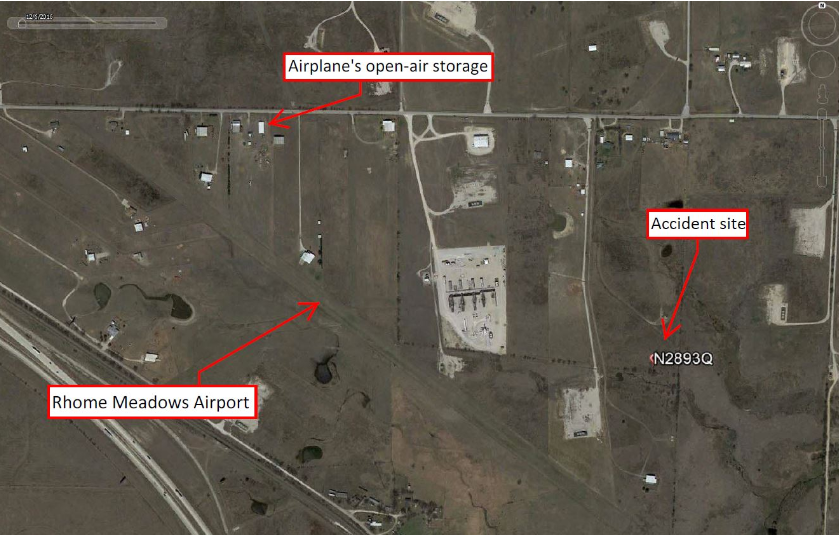
A family member stated that the pilot retrieved the airplane from under the open-air shelter for “family fun night” and was giving rides to several family members. The family members stated that the pilot had flown the airplane about one week before the accident, then again two times immediately preceding the accident flight. The two preceding flights lasted about 20 minutes and 10 minutes respectively and the family members reported no anomalies with the airplane. They also stated that during the accident flight the airplane departed from the grass runway and did not gain much altitude before it banked hard to the left and then descended behind a tree line. Figure 1 represents a satellite map view of T76 and the accident location.
A pilot-rated witness reported that he saw the airplane depart T76 and then land soon after. The airplane taxied back and three passengers boarded with the engine still running. He stated that the airplane taxied back to the runway and started the takeoff roll, during which the engine did not sound like it was developing full power. The takeoff roll was longer than he expected, and once the airplane was airborne, the nose pitched up “very high” to about 50 ft above ground level (agl), then the nose came back down. The airplane flew low over the runway and appeared to accelerate until it pitched up and climbed to about 300 ft agl. The airplane then made a left turn and descended out of view.
On his most recent second-class medical certificate application, dated October 13, 2017, the pilot reported 8,000 total hours of flight experience and 125 hours in the preceding 6 months. The pilot’s wife stated that he did not log his recent flight time and had not recorded flights in his pilot logbook since the 1990s.
During the flight, the pilot was seated in the front right seat with a minor in the front left seat; an adult and minor were seated on the rear bench seat.
The pilot’s wife stated that the airplane’s maintenance logbooks were never received from the previous owner after the airplane was purchased in 2013. There was no documentation of maintenance performed since that time and no evidence that the airplane had received an annual inspection. A representative for the previous owner could not find the logbooks.
Family members stated that fuel cans, which were filled at another airport, were typically used to refill the airplane; those fuel cans were used to fuel the airplane on the night of the accident. The fuel cans were filled at an unknown time the week before the accident.
The airplane came to rest inverted on a southeast heading about 350 yards north of the departure end of runway 13 (see figure 2).
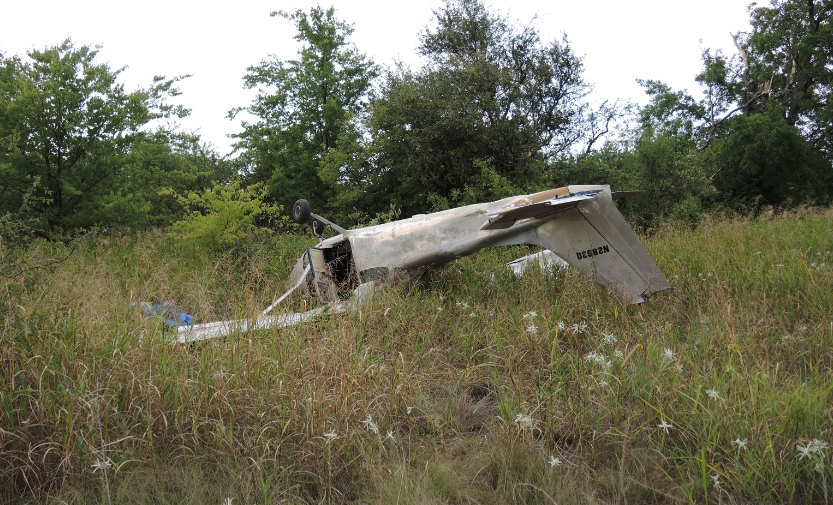
A postaccident examination of the accident site and wreckage revealed that the left wing leading edge was crushed aft and sustained impact damage, including evidence of tree strikes; the wing was partially separated from the fuselage and distorted aft. The right wing leading edge was crushed aft. All flight control cables were traced from their respective control surfaces to the cockpit controls with no separations or anomalies noted. The elevator trim tab was slightly nose-down but near neutral. The flaps were retracted. The right control yoke was separated at the control column, consistent with impact damage. The left control yoke was damaged consistent with impact.
There were no shoulder harnesses installed. The adult passenger reported that all occupants wore lap belts during the flight, and all four lap belts appeared to exhibit stretching in the webbing, indicative of the belts being worn during impact. The right rear lap belt was found separated from the eyelet at the floorboard. The left front seat was improperly safety-wired.
The fuel selector handle and valve were found in the OFF position; first responders reported that they moved the handle to OFF after the accident. A small amount of fuel was found in the firewall fuel strainer. The fuel was tested for water using water-detecting paste; the test was negative. The left and right wing fuel tanks were impact damaged, but about 2 gallons of fuel were drained from the tanks during the recovery process.
Two empty beer cans were found in the front left floorboard area near the rudder pedals. A rodent’s nest was found inside the left wing near an area that had been impact damaged. A significant amount of cobwebs were observed in the engine compartment. The airbox was clear of obstructions. A large mud dauber nest was found on the fins of the oil cooler. The ELT was found in place with battery acid residue on the outside of the case. An automotive battery was installed in the airplane.
The tip of the propeller spinner was bent but the rest of the spinner was mostly undamaged. The 2 propeller blades were straight and undamaged with no chordwise scratches or leading edge damage.
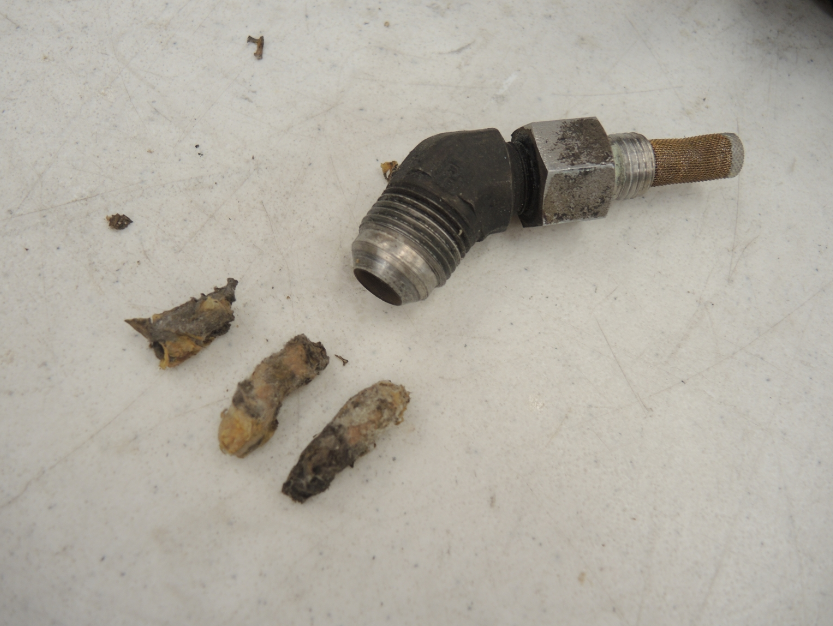
The gascolator fuel strainer was disassembled and organic debris similar to insect cocoons was found inside the strainer screen (see figure 3). The strainer bowl was mostly full of blue-colored fuel consistent with 100LL aviation gasoline.
The main fuel line from the gascolator to the carburetor was a hydraulic hose manufactured in July 2013 and featured a Department of Transportation marking consistent with an automotive hydraulic hose.
Engine crankshaft and camshaft continuity was confirmed by manually rotating the propeller. Thumb suction and compression was obtained for each cylinder. Normal rocker and valve movement was observed and all accessory gears rotated at the back of the engine. The exhaust system sustained damage to the heat exchanger, which was breached as a result of the accident. All of the flame cones were deteriorated and missing.
The carburetor was removed and disassembled; the float chamber contained about 5 mL of fuel. The fuel was tested for water using water-detecting paste; the test was negative. Both magnetos were secure on their respective mounts. The ignition timing was verified at 25° before top dead center on the left magneto. The left magneto was actuated by rotating the propeller by hand, it produced spark at all outlet points. The right magneto was secure on its mount. The ignition timing was verified about 30° before top dead center. The right magneto was removed from its mount and rotated using an electric drill, it produced spark at all outlet points. The top spark plugs were removed and exhibited a color consistent with normal combustion. The oil filter did not display any information regarding the last time it was changed.
Southwestern Institute of Forensic Sciences, Dallas, Texas, completed an autopsy on the pilot and determined the cause of death was “blunt force injuries.” The autopsy discovered evidence of hypertensive and atherosclerotic cardiovascular disease, including cardiomegaly, left ventricular hypertrophy, a fusiform aneurysm in the right coronary artery, and moderate atherosclerosis of two other coronary arteries.
Toxicology testing performed by the FAA Forensic Sciences Laboratory identified ethanol in subclavian blood, vitreous fluid, and urine (0.154 gm/dL, 0.177 gm/dL, and 0.194 gm/dL respectively); and 0.0033 μg/mL of delta-9-tetrahydrocannabinol (THC) in the blood. THC’s active metabolite, 11-hydroxy-delta-9-THC, was not detected, but the inactive metabolite, carboxy-delta-9-THC, was detected at 0.0139 μg/mL. Both THC metabolites were detected in urine; 11-hydroxy-delta-9-THC at 0.0094 μg/mL and carboxy-delta-9-THC at 0.0346 μg/mL.
Ethanol is a social drug commonly consumed by drinking beer, wine, or liquor. Ethanol acts as a central nervous system depressant; it impairs judgment, psychomotor functioning, and vigilance. Effects of ethanol on aviators are generally well understood; it significantly impairs pilots’ performance, even at very low levels. Title 14 CFR Section 91.17 (a) prohibits any person from acting or attempting to act as a crewmember of a civil aircraft while having 0.040 gm/dL or more ethanol in the blood. Ethanol is water soluble, and after absorption it quickly and uniformly distributes throughout the body’s tissues and fluids. The distribution pattern parallels water content and blood supply of the tissue. A small amount of ethanol can be produced after death by microbial activity, usually in conjunction with other alcohols such as methanol; vitreous humor and urine do not suffer from such production. Postabsorption, vitreous humor has about 12% more ethanol than blood and urine about 25% more ethanol than blood.
THC is the primary psychoactive substance in marijuana, which is listed as a schedule I controlled substance. THC’s mood-altering effects include euphoria, relaxed inhibitions, disorientation, image distortion, and psychosis. THC is stored in fatty tissues and can be released back into the blood long after consumption. While the psychoactive effects may last for a few hours, THC may be detected in the blood for days or weeks. Low THC levels of a few nanograms per milliliter in blood can result from relatively recent use (e.g., smoking within 1 to 3 hours) when some slight or even moderate impairment is likely to be present, or it can result from chronic use where no recent ingestion has occurred and no impairment is present. Thus, the level of THC in the blood and level of impairment do not appear to be closely related. See the NTSB Medical Factual Report in the public docket for additional information and references.